|
Saltwater Aquarium Lionfish
|
Lions are hardy fish that will adapt well to
life in a home or office aquarium. Provide Lion fish with liverock
or other items to provide ample hiding places. For a diet in
the aquarium, include frozen meaty foods such as live shrimp,
live fish, and occasionally crustacean flesh. Because lionfish
will usually prefer live foods, when first introduced into the
aquarium feed live saltwater feeder shrimp to entice your lion
to eat. While acclimating to its new home, Expect your lion to
be shy and hide, but lionfish are generally found out in the
open once accustomed to their surrounds. Be wanted that lions
may eat smaller fish, shrimp, and other crustaceans in the tank. |
Aquarium Conditioned Volitan Lionfish
Pterois volitans
Description: The Volitan Lionfish has vertical stripes along its
body that vary in color from red, to dark burgundy. has eye catching
banded spines on the dorsal fin and large flowing pectoral fins.
Known to spend time out in the open at dusk and dawn, but will
hide in caves in daylight. Due to the venomous nature of the
dorsal spines on the lionfish, exercise caution when working
in the tank.Adapts to captivity easily when provided with adequate
hiding spots such as crevices and caves. Plenty of swimming room
is needed as is subdued lighting as this species is more active
at night than during the day. It may eat smaller fish, shrimp,
and other crustaceans in the tank.
Recommended minimum tank
size: The Volitan Lionfish
can grow to be from 12 to 15 inches in the ocean, smaller in
an aquarium. Therefore when full grown house in at least a 125
gallon aquarium.
Food and diet:
A Lionfish diet consists of meaty foods
such as live shrimp, live fish, and crustaceans. When first brought into your home
aquarium use live saltwater feeder shrimp and feeder fish to entice your lionfish to eat.
Once comfortably eating the above in the aquarium, start working with chunks of uncooked table shrimp, pieces of thawed out silversides, and pieces of thawed out frozen squid.
Reef Compatability:
Interesting reef tank resident, but will eat shrimp, crustaceans and small fish.
Level of Care:
Advanced Aquarist
Guarantee Note:
Because the requirement of continuous live food, there is an increased level of
care required. So this species has been designated Difficult for Advance Aquarist's Only. As an Advanced Aquarist Species,
there is no long term guarantee, they have a guarantee to arrive alive and healthy, but there is no long term guarantee.
Approximate Purchase Size:
Medium 3" to 5" Large 5" to 7" XLarge 7" to 8" Show Size 8" to 10"
|
Medium $89.99
Large $199.99
XLarge$389.99
Show Size$499.99
|
Aquarium Conditioned Dwarf Lionfish
Dendrochirus zebra
Description: The Dwarf Lionfish
which is also called the Zebra Lion Fish, is the perfect lionfish
for small aquariums. The Dwarf Lion Fish has striking markings
and long pectoral and dorsal fins. The body is reddish with five
dark bars, alternating with thin dark bars in large specimens.
There is a dark spot on the cheek. Median fins have small dark
spots. They are slow-moving and not aggressive, but can be dangerous.
Recommended
minimum tank size: The
Dwarf prefers a tank of at least 50 gallons with plenty of places
to hide & swim.
Food and diet:
A Lionfish diet consists of all meaty foods: live shrimp, live fish, and crustaceans flesh. When first brought into your home
aquarium, live saltwater feeder shrimp and smaller feeder fish must be used to entice your Dwarf lionfish to eat.
Once comfortably eating the above in the aquarium, start working with tiny chunks of uncooked table shrimp, tiny pieces of thawed out silversides, and tiny pieces of thawed out frozen squid.
Reef Compatability:
Interesting reef tank resident, but will eat shrimp, crustaceans and small fish.
Level of Care:
Difficult
Approximate Purchase Size:
Small: 1" to 1-1/2"; Medium: 1-1/2" to 2"; Large: 2" to 3" |
Small $29.99 Medium $34.99
Large $44.99
|
Aquarium Conditioned Antennata Lionfish
Pterois antennata
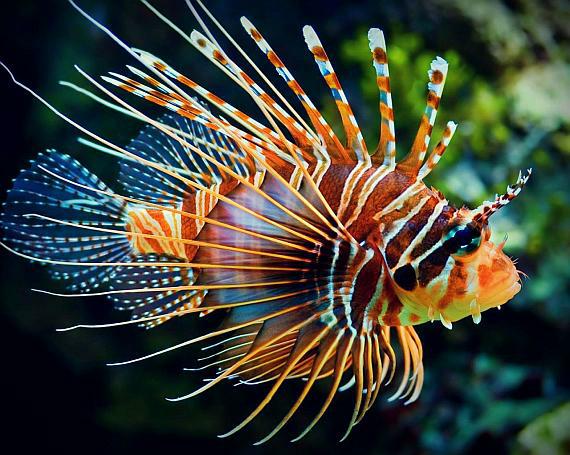
Description:
The Antennata Lionfish is easily recognized by the
spots, which are often blue, on the inner surface of the large
pectoral fins. It can be a durable aquarium fish that readily
adapts to captive life if provided with adequate hiding places.
If you keep more than one specimen, provide each individual with
its own shelter site. This species is usually indifferent toward
its tankmates, including members of its own kind and other lionfishes,
unless they are small enough to swallow. Although it feeds on
crustaceans in the wild, it will eat any fish that is small enough
to fit in its mouth in the aquarium. Provide with plenty of open
swimming space as well as caves and crevices for its to refuge
in. It may spend more time in the open in a dimly-lit tank.
Recommended minimum tank
size: The Antenata prefers
a tank of at least 30 gallons with plenty of places to hide &
swim.
Food and diet: When first brought into your home
aquarium, live saltwater feeder shrimp and small feeder fish should be used to entice
your lionfish to eat. A Lionfish diet consists of meaty foods such as live shrimp, live fish, and crustaceans.
Once comfortably eating the above in the aquarium, start working with tiny chunks of uncooked table shrimp,
tiny pieces of thawed out silversides, and tiny pieces of thawed out frozen squid.
Reef Compatability: Interesting reef tank resident, but will eat crustaceans
and small fishes.
Level of Care:
Difficult
Approximate
Purchase Size:Small: 1-1/2"
to 2-1/2"; Medium: 2-1/2" to 3-1/2"; Large: 3-1/2"
to 5" |
Small $38.99 Medium $49.99
Large $59.99
|
YOUR FISH HEALTH DEPENDS ON WHAT YOU FEED
THEM- FEED THEM THE BEST FISH FOODS
Why Use New Life
Spectrum Fish Foods?
All-natural
New Life Spectrum contains absolutely no hormones. New Life Spectrum
noticeably increases both color and vigor in both marine and
freshwater fish. Premium ingredients produce results superior
to other pellets, and even specialized fresh food (such as brine
shrimp, seaweed, etc.) without pollution. The high-density, nutritious
pellets help prevent lateral line disease, as well as other ailments
related to faltering health. New Life Spectrum provides trace
elements present in natural environments, but missing in aquariums.
Using Other Brands:
Even some hard to feed marine fish will eat New Life Spectrum
fish food. Pellets are designed with no dust and will stay in
the water for hours without disintegrating, reducing pollution.
New Life Spectrum is suitable for omnivorous, herbivorous, and
many carnivorous fish. Ounce-for-ounce, New Life Spectrum provides
far better nutrition than flake food, and is less-expensive relative
to weight.
- High-quality easily digestible krill & fish meal protein
- Balanced daily diet for all marine fish
- Boosts immune system to repel parasites
- Enhances the full spectrum of your fish's color
Click
here for more information on the importance of phytoplankton
for your corals |
|
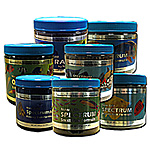
We
Highly Recommend you use
Spectrum Fish Food by Newlife
Feed your fish a better
food and watch their health and colors improve
Starting At - $7.99
|
 |
|
Copyright Aquarium Creations Online 2016
Photos are representative of each species. Each animal is unique
and variations should be expected. |