Wild
Collected, But Aquarium Conditioned
Yellow Tangs
Zebrasoma
flavescens (Hawaii)
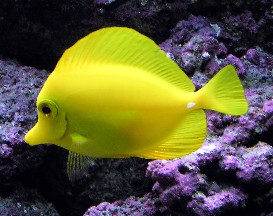
Description: This is the most well
known fish in the marine hobby. When sleeping or stressed a white
line appears on the flanks of this fish. If you are going to
keep more than one tang in the same tank it is best to introduce
them simultaneously, or to introduce smaller individuals first.
This is a good community fish. This species can be aggressive
toward surgeonfish tankmates, especially members of its own kind
or members of the genus Zebrasoma, after it has acclimated to
its new home. It will also defend a preferred hiding place from
intruders. Provide this active fish with plenty of swimming room,
as well one or two hiding places.
Recommended
Tank size: Will do best in
a reef aquarium with plenty of live rock and hiding places. It
requires a tank size of 90 gallon or larger. Like all Surgeon
Tangs, it will be aggressive with other body shape look alikes
such as Purple Tangs or Sailfin Tangs but peaceful to other fish.
If putting more than one in your aquarium, make sure to put all
in at the same time.
Food and
diet: In nature it feeds
almost entirely on brown macroalgae and should be offered a wide
a variety of foods including plenty of algae. Although Tangs
will eat meaty foods along with the other fish in the aquarium,
it is important that they are offered plenty of seaweed and algae.
These are the foods that will strengthen their immune system,
reduce aggression and improve their overall health. Offer dried
seaweed tied to a rock or use a veggie clip, and feed at least
3 times per week. Sea Veggies, Seaweed Salad and Ocean Nutrition
are all ideal products and are very easy to use.
Level of
Care: Easy
Reef Compatibility:Very good reef or community
fish.
Tempermant: Semi Aggressive
Acclimation
Time: Minimum
of 3 hours
Approximate
Purchase Size: Small 1-1/2 to 2" , Medium 2" to 3" |
Both Sizes Now 25% OFF!!
Small $38.95 , Medium $44.95
|
Wild
Collected, Aquarium Conditioned
Red Sea Purple Tangs
Zebrasoma
xanthurus (Red Sea)
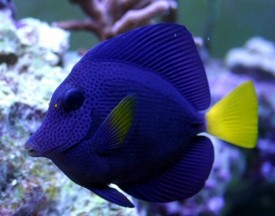
Description:One of the most desired
saltwater fish for the home aquarium, the Purple Tang was brought into the aquarist trade back in
the 1960's, and origionally collected only in the Red Sea, they
have now been found in other locations such as the Gulf of Eden
and in the Arabian Sea. Other names this beauty is known by is
the Yellowtail Sailfin Tang, Yellowtail Surgeonfish, and Blue
Surgeonfish. Adults in the wild will grow to about 10 inches,
smaller of course in an aquarium.
Tank Recommendations:Will do best in a reef aquarium with
plenty of live rock and hiding places. It requires a tank size
of 90 gallon or larger. Like all Surgeon Tangs, it will be aggressive
with other body shape look alikes such as Yellow Tangs or Sailfin
Tangs but peaceful to other fish. If putting more than one in
your aquarium, make sure to put all in at the same time.
Food and
diet: The Purple Tang will
eat all foods including meaty foods, but since it is a herbivore
it must be provided with a varied diet that includes frozen and
flake foods for herbivores as well as dried algae sheets to obtain
the nescessary vitamins and minerals. These are the foods that
will strengthen their immune system, reduce aggression and improve
their overall health. Offer dried seaweed tied to a rock or use
a veggie clip, and feed at least 3 times per week. Sea Veggies,
Seaweed Salad and Frozen Foods for Surgeon Tangs will be a great
balanced diet.
Level of
Care: Easy
Reef Compatibility:Very good reef or community
fish.
Tempermant: Semi Aggressive
Acclimation
Time: Minimum
of 3 hours
Approximate
Purchase Size: Small 1-1/2 to 2" , Medium 2" to 3" |
Both Sizes Now 30% OFF!!
Small $129.95 Medium $149.95
|
Wild
Collected, Aquarium Conditioned
Blue Hippo Tang
Paracanthurus
hepatus (Indonesia)
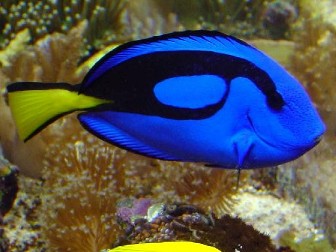
Description: The Blue Tang also called the Blue Hippo
Tang is a beautiful royal blue, with a black palette pattern
on the side and a yellow tail. Of the thousands of fish available
to the trade, this is one of the most popular of them all! In
the famous movie Finding Nemo the Blue Tang is "Dory",
sidekick to loveable "Nemo". Shy, especially when first
introduced to the aquarium, the Blue Tang should be provided
with coral, live rock, or other suitable shelter sites. The Blue
Tang will lie on is side (often startling those unaware of it's
behavior) if it cannot find a suitable hiding place, or when
first introduced into the aquarium. This species is usually more
docile than many other Surgeonfishes, and gets along great in
a peaceful community or reef tank.
Recommended
Tank size: They
need a 50
gallon or larger aquarium
with a number of hiding places and plenty of room to swim.Smaller
size Blue Tangs can be housed in 70 gallon and larger aquariums.
To keep multiple specimens, you must introduce the entire lot
at once into the marine system.
Food and
diet: In nature it feeds
almost entirely on brown macroalgae and should be offered a wide
a variety of foods including plenty of algae. Although Tangs
will eat meaty foods along with the other fish in the aquarium,
it is important that they are offered plenty of seaweed and algae.
These are the foods that will strengthen their immune system,
reduce aggression and improve their overall health. Offer dried
seaweed tied to a rock or use a veggie clip, and feed at least
3 times per week. Sea Veggies, Seaweed Salad and Ocean Nutrition
are all ideal products and are very easy to use.
Level of
Care: Moderate
Reef Compatibility:Very good reef or community
fish.
Tempermant: Semi Aggressive
Acclimation
Time: Minimum
of 3 hours
Approximate
Purchase Size: Tiny
1/2" to 3/4" , Small 1 to 1-1/2"
Small/Medium 1-1/2" to 2-1/2" , Medium 2-1/2"
to 3-1/2"
Medium/Large 3-1/2" to 4-1/2" , Large 4-1/2" to
5-1/2" , XLarge 5-1/2" to 8" |
All Sizes Now 20% OFF!!
Tiny $44.95 Small
$54.95 Small/Medium $69.95 Medium $89.95
Medium/Large $129.95 Large
$169.95 |
|
Wild
Collected, Aquarium Conditioned
Gold Band Maroon Clownfish
Premnas
biaculeatus
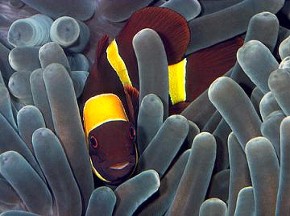
Identification:The Gold Band Maroon
Clownfish (Premnas biaculeatus) typically has a deep red body
color and three thin gold stripes: behind the head, through the
middle of the fish and at the base of the tail. The Goldstripe
Maroon Clownfish is a natural color variety that has thicker
golden yellow stripes instead of white. Small individuals may
have very faintly yellow or ivory-white stripes which deepen
to gold as the fish matures. Clownfish are some of the hardiest
and most traditional fish for marine aquariums. These very popular
fish are easy to keep in aquariums, although they do not get
along with each other. Unless a hobbyist can get a mated pair,
it is best to keep them one to a tank.
Note: The Gold Band Maroon
Clownfish does not require a host anemone for survival; however
it is a real treat for any hobbyist to observe the symbiotic
relationship between the clownfish and its host anemone. The
anemone provides a safe haven for the clownfish because its tentacles
will inflict a painful sting on all but other clownfish. The
clownfish, in return, chases off fish that threaten to pick at
the anemone and brings it scraps of food. The Gold Maroon Clownfish
adapts to almost all common sea anemones, but prefers the Bubbletip
Anemone.
Minimum tank
size: 20 gallon or larger
Feeding and
diet: Goldband
Maroon Clownfish will eat a wide variety of prepared flake, pellet
and and frozen meaty and herbavore fish foods.
Level of
Care: Easy
Reef Compatibility:
Excellent Reef Fish
Tempermant: Semi-Aggressive
Acclimation
Time: 3+
hours
Approximate
Purchase Size: Small: 1"
to 1-1/2" , Medium: 1-1/2" to 3" , Large: 3"
to 4" , XLarge 4" to 5" |
All Sizes Now 15% OFF!!
Small $44.95
Medium $49.95 Large
$89.95 XLarge $129.95
Indo Pacific Mateed
Pair $199.95
|
ORA®
Certified Captive Bred
Premium Black
Ice Snowflake's
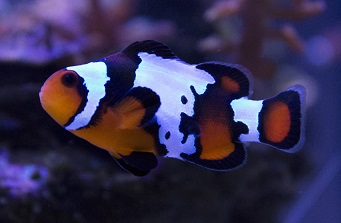
Identification:The Black Ice Snowflake
(Amphiprion ocellaris) from ORA is the result of attempting to
make a Black Snowflake Clownfish. ORA crossed a Black Ocellaris
with a Ultra Snowflake clownfish. The result is these beautiful
fish have a brilliant yellow/orange bodies with ultra intense
black markings around the very jagged and angular edged white
bars. The ultra intense black really make the colors pop. No
two Black Ice Snowflake Clownfish are exactly alike.
Why Should You Want Captive Bred Saltwater Fish
The most important benefit of purchasing tank bred clownfish
is that tank bred clownfish are hardier than their wild caught
counterpart and additionally very accustomed to aquarium conditions
and aquarium food..They are more "forgiving" if your
water chemistry is not perfect where as the same not perfect
water chemistry would most likely shorten the life dramaticaly
of the wild ocean born clownfish.
NOTE: No two Black Ice Snowflake Clownfish are exactly identical
and the fish you receive may varyin appearance from the example
pictured here.
Minimum
tank size: 20 Gallon
Feeding and
diet: Black
Ice Snowflake Clownfish will eat a wide variety of prepared flake,
pellet and and frozen meaty and herbavore fish foods.
Level of
Care: Easy
Reef Compatibility:
Excellent Reef Fish
Tempermant: Semi-Aggressive
Acclimation
Time: 3+
hours
Approximate
Purchase Size: 3/4"
to 1-1/4" |
Regular Price $99.99 Now 37%
OFF!!
Sale Price $63.95
|
Wild
Collected, Aquarium Conditioned
Naokae's
Fairy Wrasse
Cirrhilabrus naokoae
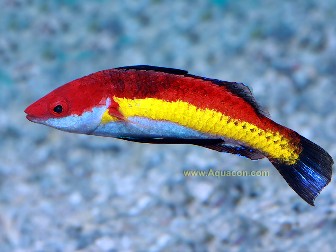
First described
by Jack Randall and Dr. Hiroyuki Tanakain
January 2009, this often hard to find Fairy Wrasse is a real
beauty!
Factoid: This fish is named after Hiroyuki Tanaka's wife.
Description: The rare (and some would
say ULTRA-RARE) Naoko’s Fairy Wrasse is a reef-associated,
tropical wrasse from the eastern Indian Ocean, and it makes a
fantastic aquarium fish. First described by Jack Randall and
Dr. Hiroyuki Tanaka in January 2009, this is a fairly peaceful
wrasse that is both active and hardy.It is a very active fish
and rarely hides in crevices. It has done well in peaceful community
reefs or fish-only tank's (especially with other fairy wrasses
from the genus Cirrhilabrus). There have been multiple cases
of successfully keeping multiple Naokae's together, but you must
put them in at the same time. When flashing the colors are pure
beauty with the tail turning a brilliant blue as well!
Recommended Tank size: A sand bed
and Live Rock should be provided for all Fairy and Filament Wrasses.They
will bury themselves in the sand to sleep or hide. Live Rock
provides numerous small life forms that the Wrasses consider
a tasty treat as well as another place to hide when they feel
threatened. A
55 gallon or larger aquarium, with a shaded area is recommended.
Will not pick on corals or invertebrates, making them an ideal
fish for the reef aquarium.
Feeding and
diet:Multiple Small Meals
Of Nutrient-rich Foods Will Help Keep This Wrasse Healthy And
Its Color Vibrant. As with other members of the Fairy Wrasse
family, its diet should be carnivorous including meaty frozen
foods or Brine Shrimp. A sand bed and Live Rock should be provided
for all Wrasses. Live Rock provides numerous small life forms
that Wrasses consider a tasty treat as well as another place
to hide when they feel threatened.
Reef Compatability:
Excellent
Reef fish. Safe And Ideal
For Reef Aquariums. Will Not Harm Invertebrates And Benefits
From The Numerous Hiding Places in A Well-stocked Reef.
Level of
Care: Easy
Tempermant: fairly peaceful
Acclimation
Time: 3+
hours
Approximate
Purchase Size: 2-1/4"
to 3"
View Youtube
Video: https://youtu.be/KPcgQVZmBqc |
Regular Price $149.99 Now
40% OFF!!
Sale Price $89.95
|
Wild Collected, Aquarium Conditioned
Purple Firefish Goby
Nemateleotris decora
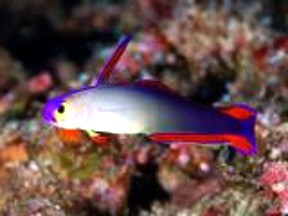
Description: The Purple Firefish from
Maldives is a magnificent little fish that's perfect for reef
tanks. These fish have a light lavender colored body with purple
markings on their face and towards their tailfin, along with
dark red and purple colored fins. The Purple Firefish also has
an elongated first dorsal spine that "jumps" up and
down. These little fish have lots of personality and should be
kept in a tank with lots of rockwork. The Purple Firefish likes
lots of crevices, caves, and overhangs where they can "hang"
in place. These fish prefer to be kept in pairs and do well in
the home aquarium. They are great for reef tanks and will accept
most fish foods.
Husbandry
Requirements: The
Purple Firefish requires an established reef aquarium of at least
10 gallon's and we recommend plenty of loose coral rubble or
rock as part of its home. The Purple Firefish rarely will become
aggressive toward any other saltwater fish.
Feeding and
diet: The Purple Firefish
Goby is a carnivore. It eats zooplankton, finely chopped small
crustaceans, live & frozen brine shrimp, mysis shrimp, algae,
spirulina flakes and other quality flake foods. Gobies will not
touch corals and are too small to eat most crustaceans, so they
are reef safe. You
can supplement their diet with live copepods from AlgaGen called
Tisbe Copepods. Adding a refugium to your system will once established,
provide an excellent source of live food.
Level of Care: Easy
Reef Compatibility:Very good reef or community
fish.
Tempermant: Peaceful
Acclimation
Time: Minimum
of 3 hours
Approximate
Purchase Size:
2" to 2-3/4" |
Regular Price $39.99 Now 40%
OFF!!
Sale Price $23.95
|
Wild
Collected, But Aquarium Conditioned
Royal Gramma Basslet
Gramma
loreto
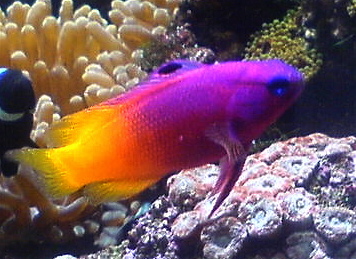
Description:The Royal Gramma is a
bicolored fish in the basslet family. It is one of the most recognizable
species of basslets in the hobby. It is also an excellent fish
for a beginner hobbyist as it is hardy and easy to care for.
In the ocean they live in cave areas that hide it from the bright
lighting. In an aquarium try to give them some area of rock work
resembling a cave for it to retreat to when it wants to. Though
perfectly friendly and peaceful with tankmates of close size,
the Royal Gramma is territorial with its own species. That means
it will be aggressive toward other basslets so we suggest only
one per tank.
Husbandry
Requirements: The
Royal Gramma requires an established reef aquarium of at least
10 gallon's and we recommend plenty of loose coral rubble or
rock as part of its home.
Feeding:
Any aquarium
diets for carnivores is fine, we feed small pieces of seafood such as mussel, daphnia, brine
shrimp, bloodworms, or other meaty foods. When feeding frozen
aquarium food it would be a very wise to provide some vitamins
to the frozen mix. Our favorite choices are Selcon or Vita Chem.
Level of
Care: Easy
Reef Compatibility:Very good reef or community
fish.
Tempermant: Peaceful
Acclimation
Time: Minimum
of 3 hours
Approximate
Purchase Size:
1-1/4" to 2" |
Regular Price $29.99 Now 40%
OFF!!
Sale Price $17.95
|
Wild
Collected, But Aquarium Conditioned
Blue Mandarin
Pterosynchiropus
splendidus
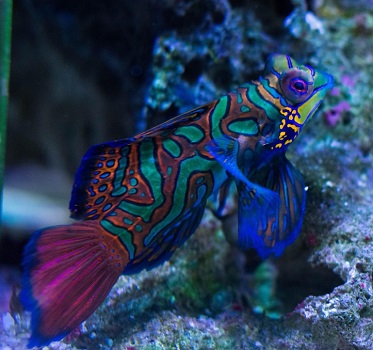
Description: The Blue Mandarin also called the Red Mandarin,
Green Mandarin Dragonet, or Psychedelic Mandarin fish can simply
not be confused with any other fish. It has arguably the most
attractive coloration and pattern of any commonly kept reef fish.
The scale-less body of the fish is a blue or green color which
has bright Red wavy lines across it. The tail is bright red with
blue edging. Other colors can be found in the pattern as well.
Mandarins help to prevent brown flatworm infestations, which
can be trouble for some reef aquariums. The Mandarinfish will
hover and scoot around your reef aquarium without bothering any
corals,clams,or nvertebrates. It is best kept with other docile
fishes in a community reef aquarium.
Husbandry
Requirements: The
Mandarin requires an established reef aquarium with plenty of
live copepods available to feed on. You can supplement its diet
with live copepods from AlgaGen called Tisbe Copepods. Adding
a refugium to your system will once established, provide an excellent
source of live food. The minimum tank requirement is generally
stated as 29 gallon with 50lbs or more of live rock. This is
based on feeding requirements and not space requirements as the
Mandarin is a very slow, docile fish.
Feeding:
Any aquarium
diets for carnivores is fine, we feed small pieces of seafood such as mussel, daphnia, brine
shrimp, bloodworms, or other meaty foods. When feeding frozen
aquarium food it would be a very wise to provide some vitamins
to the frozen mix. Our favorite choices are Selcon or Vita Chem.
Level of
Care: Difficult to keep in
the home aquarium because they are picky eaters thus they should
be reserved for the experienced aquarists only.
Reef Compatibility:Very good reef or community
fish.
Tempermant: Peaceful
Acclimation
Time: Minimum
of 3 hours
Approximate
Purchase Size:
Medium 2" to 21/2" |
Both Offers are Now 35% OFF!!
Regular Price $29.99
Sale Price $19.95
A few Mated Pairs Now Available $59.95
|
|